Is AI Creating Technical Debt? Yes — and Faster Than Reviews
AI doesn't create bugs on purpose. It creates debt on autopilot — plausible code nobody owns, tested, or priced.
Short answer: yes, and it's fast
AI coding tools are the fastest junior developer you've ever hired: tireless, confident, and wrong in ways that look right. Output doubles while review capacity stays flat — so plausible-but-unowned code merges every day. That's textbook technical debt: works now, taxes later.
This isn't an argument to stop using AI. It's an argument to price what AI ships — because debt you measure gets paid down, and debt you ignore compounds.
4 ways AI creates debt
| Pattern | Why it hurts | Guardrail |
|---|---|---|
| 1. Unowned logic | Developers merge code they wouldn't have written, without the mental model to debug it at 2am. No owner, so nobody refactors it later. | Mandatory human owner on every AI-assisted PR |
| 2. Missing tests and edge cases | AI nails the happy path and skips auth failures, retries, pagination, and time zones. Coverage looks fine; resilience isn't. | No tests, no merge — ask for the edge cases every time |
| 3. Outdated APIs and patterns | Models trained months ago suggest deprecated endpoints and old frameworks. It compiles today, becomes migration debt tomorrow. | Ban blind dependency upgrades; verify against current docs |
| 4. Duplicated patterns at scale | Ask five times, get five slightly different helpers for the same job. Copy-paste used to be one developer's sin — now it's automated. | One owner per shared helper; review for reuse before merge |
What AI debt costs in $/day
Same math as always: principal = hours × rate, daily burn = principal × APR ÷ 365. Say an AI-generated auth helper needs a 12-hour rewrite at $80/h: ~$960 principal, ~$0.32/day at 12% APR. Harmless alone — but ten such helpers across a codebase is ~$9,600 burning ~$3.20/day, ~$1,170/year. Full method in how to calculate debt in $/day.
AI doesn't make debt more expensive per item. It makes more items per week — which is why avoiding accidental debt now matters more than ever.
Price one AI-generated shortcut — 30 seconds, same math as the app.
Try the debt calculator5 guardrails that actually work
- Flag AI-assisted PRs for extra review. Smaller diffs, mandatory human owner — no drive-by merges.
- Tests with every AI block. No tests, no merge. AI writes decent tests when asked — ask every time.
- Ban blind dependency upgrades. Verify every suggested API against current docs. Outdated suggestions are the costliest AI debt.
- Tag and price at merge. Label AI-assisted debt items, estimate optimistic/likely/pessimistic hours, set rate and APR. Unpriced AI code becomes mystery debt in 90 days.
- Schedule payoff weekly. Top AI-debt items by burn and 0–100 score go into the next 30/60/90-day slice. Check how much debt is acceptable to know when to pause features.
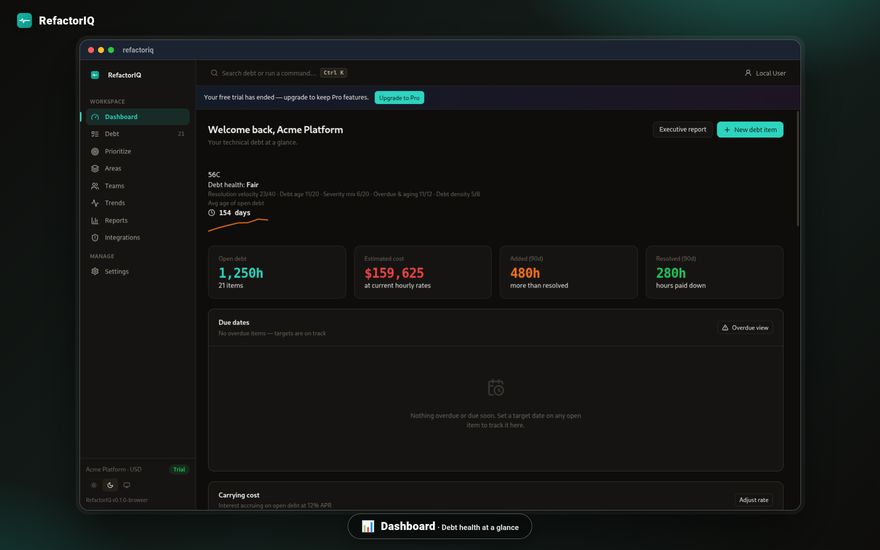
Track AI debt before it compounds. Free Demo, 15-day Pro trial, no account.
Download RefactorIQFAQ
Is AI creating technical debt?
Yes. AI assistants generate plausible code faster than teams can review it — unowned logic, missing tests, outdated APIs, and duplicated patterns. Speed is real; so is the carrying cost if nothing is priced and scheduled.
Why does AI-generated code create more debt?
Because it looks correct and skips the understanding step. Developers merge code they wouldn't have written themselves, without the mental model to maintain it. No owner, no tests, no edge cases — classic debt.
Should teams stop using AI coding tools?
No — throttle and guardrail them instead. Require human review, tests for every AI block, and debt pricing at merge. AI plus guardrails ships faster and cheaper than either alone.
How do you track AI-generated tech debt?
Tag AI-assisted items, estimate optimistic/likely/pessimistic hours, price principal = hours × rate and daily burn = principal × APR ÷ 365, then rank 0–100 and schedule payoff against capacity.
What is the first guardrail to add this week?
Start with the merge-time price tag: every AI-assisted pull request gets optimistic, likely, and pessimistic hours plus an owner before it merges. One field, one habit, no new tooling. Teams that price at merge catch the expensive patterns — unowned modules, missing tests, stale APIs — while the context is fresh, instead of discovering them as mystery debt next quarter.