How to Avoid Tech Debt (Without Slowing to a Crawl)
Zero debt means zero shipping. The goal isn't avoidance — it's cheap, visible, intentional debt.
Start with the right mindset
You can't avoid all technical debt — every deadline forces a tradeoff. Teams that chase zero debt review every PR for a week and ship nothing. Teams that ignore debt ship fast for six months, then grind to a halt paying 3x for every change.
The winning middle: avoid accidental debt with process, and make intentional debt cheap by pricing and scheduling it. Most avoidable debt comes from five process failures, not talent: skipped tests, no review, copy-pasted logic, missing docs on tricky code, and "temporary" shortcuts with no owner or date.
6 habits that prevent 80% of debt
| Habit | Debt it prevents | How to check it holds |
|---|---|---|
| 1. Enforce definition of done | Untested, unreviewed code shipping as "small" | Every merged PR has tests and ≥1 reviewer; no exemptions |
| 2. Keep PRs small (~300 lines) | Large unreviewed merges that nobody understands later | Median PR size under 300 lines; AI-assisted code flagged for extra scrutiny |
| 3. Estimate three numbers | Single-point estimates that hide uncertainty until it is expensive | Tasks carry optimistic / likely / pessimistic hours, not one number |
| 4. Score shortcuts 0–100 | Unscheduled debt that never gets paid | Every logged shortcut has severity, risk, impact, frequency, and age scored |
| 5. Reserve 15–20% capacity | Interest that compounds because no sprint ever pays principal | Payoff capacity is a standing line item, not a quarterly ask |
| 6. Expire stale tickets | A 5,000-ticket backlog that is avoidance disguised as tracking | Anything untouched 90 days is re-scored or closed |
Small PRs without tests are where the most expensive debt is born, and single-number estimates lie — ranges force honesty about uncertainty and hand you a cost range for free. Both habits pay for themselves the first time a sprint plan has to defend a date.
See what your shortcuts cost — same math the app uses, 30 seconds.
Try the debt calculatorPrice the rest instead of hiding it
Some debt is the right call — shipping revenue early is leverage. But log it with a price on day one: principal = hours × rate, daily burn = principal × APR ÷ 365. A 12-hour, $80/h shortcut is ~$960 burning ~$0.32/day. Full method in how to calculate debt in $/day.
Then schedule it: top items by burn and score that fit weekly capacity go into a 30/60/90-day plan. "This sprint saves ~$540/yr" gets approved. "Trust us, the code is messy" doesn't. And check how much debt is acceptable so you know when to stop features and pay down.
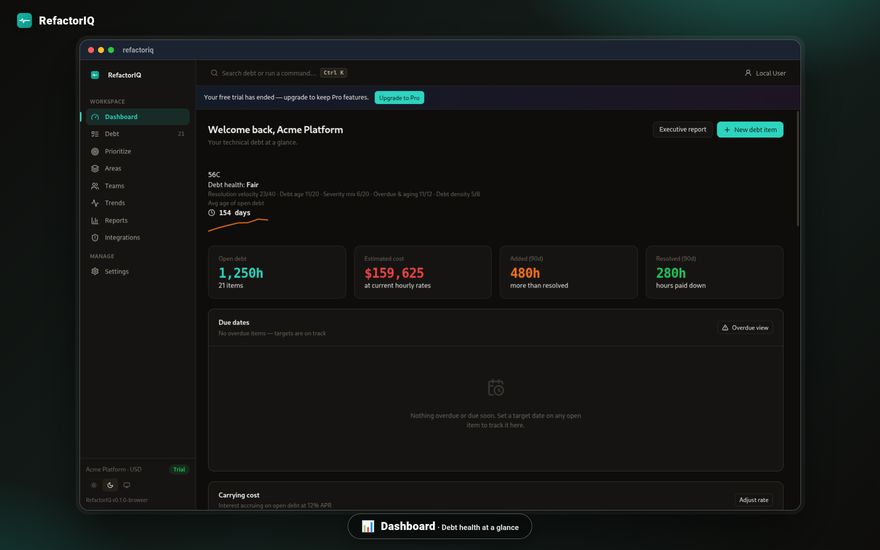
Stop hiding debt in tickets. Price it, rank it, schedule it — free Demo, no account.
Download RefactorIQFAQ
How can tech debt be avoided?
Prevent 80% with six habits: strict definition of done, 20% payoff capacity, three-point hour estimates, 0–100 scoring, small PRs with tests, and quarterly payoff plans. Price the rest instead of hiding it.
Can you fully avoid technical debt?
No — and trying costs more than the debt. Shipping requires tradeoffs. The goal is intentional, priced, scheduled debt, not zero debt.
What causes the most avoidable tech debt?
Skipped tests, no code review, copy-pasted logic, missing docs for tricky code, and 'temporary' shortcuts with no owner or target date. All five are process failures, not talent failures.
How much capacity should go to preventing debt?
Reserve 15–20% of every sprint for payoff plus enforce definition of done on every ticket. That steady interest payment beats a painful 'debt quarter' once a year.
How do you measure whether prevention is working?
Watch three numbers over 90 days: the share of items older than 180 days should fall, resolved hours should stay above 70% of added hours, and portfolio daily burn should flatten or drop. If all three move the right way, your habits are paying interest on schedule. If burn keeps climbing while the other two look fine, estimates are lying — recalibrate rates and APR first.