SQALE Method Vs PERT-Based Carrying Cost Estimation Explained
SQALE Method Vs PERT-Based Carrying Cost Estimation Explained — a focused guide for engineering managers: what to do, what to measure, and what to avoid so this work stays separate from adjacent efforts.
Side-by-side criteria for this choice
SQALE Method Vs PERT-Based Carrying Cost Estimation Explained is a buy/build/borrow decision. Score accuracy, maintenance, privacy, and auditability — not just license cost. A spreadsheet is free until it costs an hour a week and no one trusts the numbers.
| Criterion | Option A | Option B |
|---|---|---|
| Accuracy | Medium, manual | High, audited |
| Maintenance | ~1h/week | Near zero |
| Privacy | Local file | Check upload |
| History | None | Trend + audit |
Compare with real numbers.
Try the calculatorVerdict by team size
Under ~10 devs: start manual, timebox maintenance. 10–50: switch when rework or audit needs exceed spreadsheet trust — typically when SQALE method vs PERT-based carrying cost touches incidents or budgets. 50+: use a queryable ledger with history; wikis and labels do not survive personnel change. See tracking complements and valuation math for inputs.
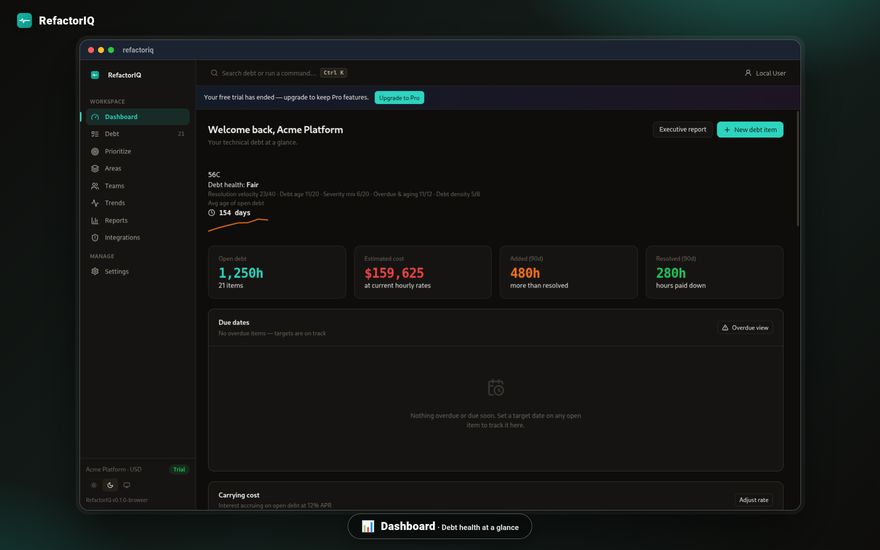
Migration path that sticks
- Import: top 20 items with hours, rate, APR in one CSV.
- Parallel run: two weeks dual-entry, then cut over.
- Retire: freeze the old sheet, link it once, archive.
Import once, report forever — offline.
Download RefactorIQWhat comparisons do not do
Comparisons choose tooling; they do not teach single-tool operation, define debt from scratch, or run ceremonies. Pick the tool here — learn it in its own guide.
Worked example: pricing this in dollars per day
Here is the arithmetic behind the argument. Take a single item from this guide and price it the way the calculator on the product page does it:
principal = hours × blended rate
daily carrying cost = principal × APR ÷ 365
| Input | Value | What it tells you |
|---|---|---|
| Effort to fix | 12 h | Your estimate of the work, not the wish |
| Blended rate | $95/h | Loaded cost, not salary |
| Principal | $1,140 | The value sitting in the code |
| APR | 8% | Drag: slower changes, bugs, onboarding tax |
| Daily carry | ~$0.25/day | What waiting costs today |
| Yearly carry | ~$91/yr | What waiting costs for twelve months |
Run the same row twice before you believe it. Halve the hours because you are optimistic and the carry still lands near $46 a year; double them because the migration has a hidden dependency and it is ~$182. For your team that is the difference between a line item and a rounding error, which is exactly why the range has to travel with the number.
One quarter of drift on this item costs about $23. That figure is the whole argument — it is small enough to be ignored in a roadmap review and large enough to matter once it compounds across a backlog.
What this guide does not cover
This post stays narrow on purpose. It does not go into single-tool how-to, generic debt definition, or unrelated sprint ceremony guide, because those are separate decisions with their own inputs and their own audience. If you are weighing sQALE Method Vs PERT-Based Carrying Cost Estimation Explained specifically, read this alongside Build-Your-Own Grafana Vs Dedicated Tech Debt Reporting Tool rather than trying to stretch either one to cover the other.
Key takeaways
- Price it before you argue about it. 12 hours at $95/h is $1,140 of principal; the debate about whether it matters stops being subjective once the number exists.
- Carry compounds quietly. ~$0.25 a day and ~$91 a year for this item, and it costs nothing to keep paying it.
- Name an owner and a date. Debt without a trigger is a wish; debt with a trigger becomes a line item.
- Show the range. Halve the estimate and the number still holds. If it does not, the estimate needs work, not the argument.
- Next step. Put the owner and the date in the backlog, not in a slide deck.
FAQ
SQALE method vs PERT-based carrying cost: which is better for scale-ups?
Start with sQALE Method Vs PERT-Based Carrying Cost Estimation Explained: about 12 hours of work at a blended $95/h, or $1,140 of principal carrying roughly $0.25 a day. State that number, then the single business outcome it protects, then ask for dated capacity. If the ask is declined, log it with a revisit trigger so the decision stays visible to the engineering manager.
What are limitations of SQALE method vs PERT-based carrying cost?
Start with sQALE Method Vs PERT-Based Carrying Cost Estimation Explained: about 12 hours of work at a blended $95/h, or $1,140 of principal carrying roughly $0.25 a day. State that number, then the single business outcome it protects, then ask for dated capacity. If the ask is declined, log it with a revisit trigger so the decision stays visible to the engineering manager.
When to switch for SQALE method vs PERT-based carrying cost?
Act once the carry compounds faster than the cost of waiting. On a $1,140 item that is $0.25 per day, so a single quarter of drift costs about $23 and a full year about $91. If the work touches code you change every sprint, that is already your trigger.