Product Requirements Doc Section For Technical Constraints Template
Product Requirements Doc Section For Technical Constraints Template — a focused guide for engineering managers: what to do, what to measure, and what to avoid so this work stays separate from adjacent efforts.
The non-technical frame for this trade-off
Product Requirements Doc Section For Technical Constraints Template lands when you translate code into dates and dollars. Never open with structure — open with impact: what ships slower, what risks an incident, what costs support time. Reference: thresholds that work and $/day math as backup, not opener.
Verbatim script that works
“If we ship the feature on this foundation, we add ~13h of drag to every future change in this area. Option A: two days now, saves repeat drag. Option B: ship now, pay ~13h plus incident risk later. I recommend A because [churn/SLA/support reason]. Can we reserve the two days?” Pause. Let them choose with costs visible.
| Option | Cost now | Cost later |
|---|---|---|
| Refactor now | 13h | Low |
| Workaround | Half day | 13h + risk |
Bring numbers to the next roadmap review.
Price the trade-offOne-slide structure
Title with dollars, three rows (burn, payoff, payback), one ask with date. Add rejected-proposal log underneath: what was declined, burn at the time, revisit trigger. Roadmaps respect memory — write it down and revisit when the trigger fires.
Handling the top objections
- “After launch”: agree a dated trigger and owner — launches without triggers become forever.
- “Just one workaround”: price three workarounds versus one fix; workarounds compound.
Make the case with data — offline.
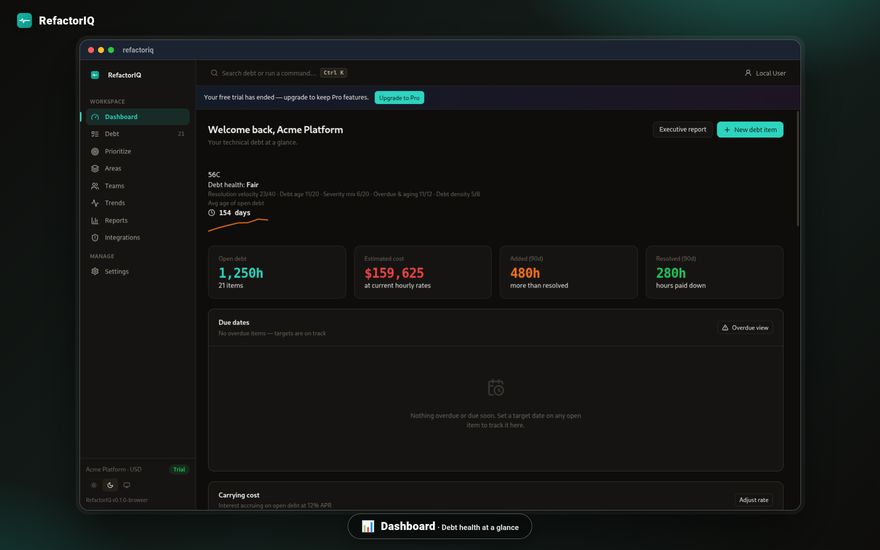
Download RefactorIQWhat stakeholder work does not do
Communication wins capacity; it does not derive statistics, implement code, or measure local persistence. Win the decision here — hand math and implementation to their own owners.
Worked example: pricing this in dollars per day
Here is the arithmetic behind the argument. Take a single item from this guide and price it the way the calculator on the product page does it:
principal = hours × blended rate
daily carrying cost = principal × APR ÷ 365
| Input | Value | What it tells you |
|---|---|---|
| Effort to fix | 13 h | Your estimate of the work, not the wish |
| Blended rate | $100/h | Loaded cost, not salary |
| Principal | $1,300 | The value sitting in the code |
| APR | 20% | Drag: slower changes, bugs, onboarding tax |
| Daily carry | ~$0.71/day | What waiting costs today |
| Yearly carry | ~$260/yr | What waiting costs for twelve months |
Run the same row twice before you believe it. Halve the hours because you are optimistic and the carry still lands near $130 a year; double them because the migration has a hidden dependency and it is ~$520. For your team that is the difference between a line item and a rounding error, which is exactly why the range has to travel with the number.
One quarter of drift on this item costs about $65. That figure is the whole argument — it is small enough to be ignored in a roadmap review and large enough to matter once it compounds across a backlog.
What this guide does not cover
This post stays narrow on purpose. It does not go into PERT math derivations, code-level patterns, or SQLite/local-first implementation, because those are separate decisions with their own inputs and their own audience. If you are weighing product Requirements Doc Section For Technical Constraints Template specifically, read this alongside Tech Debt Narrative For Board Meeting Without Jargon rather than trying to stretch either one to cover the other.
Key takeaways
- Price it before you argue about it. 13 hours at $100/h is $1,300 of principal; the debate about whether it matters stops being subjective once the number exists.
- Carry compounds quietly. ~$0.71 a day and ~$260 a year for this item, and it costs nothing to keep paying it.
- Name an owner and a date. Debt without a trigger is a wish; debt with a trigger becomes a line item.
- Show the range. Halve the estimate and the number still holds. If it does not, the estimate needs work, not the argument.
- Next step. Put the owner and the date in the backlog, not in a slide deck.
FAQ
How to convince stakeholders about product requirements doc section for technical?
Start with product Requirements Doc Section For Technical Constraints Template: about 13 hours of work at a blended $100/h, or $1,300 of principal carrying roughly $0.71 a day. State that number, then the single business outcome it protects, then ask for dated capacity. If the ask is declined, log it with a revisit trigger so the decision stays visible to the engineering manager.
What script works for product requirements doc section for technical with PMs?
One page, four rows: the item, the effort (13 h), the principal ($1,300), and the payoff. A $100/h blended rates reading one is your opening line; the rest is the ask. Keep the $0.71/day carry on the page so nobody has to recompute it in the meeting.
How to frame product requirements doc section for technical without jargon?
Start with product Requirements Doc Section For Technical Constraints Template: about 13 hours of work at a blended $100/h, or $1,300 of principal carrying roughly $0.71 a day. State that number, then the single business outcome it protects, then ask for dated capacity. If the ask is declined, log it with a revisit trigger so the decision stays visible to the engineering manager.