Mentorship Load Senior Devs Stuck Maintaining Legacy Code
Mentorship Load Senior Devs Stuck Maintaining Legacy Code — a focused guide for vp of engineerings: what to do, what to measure, and what to avoid so this work stays separate from adjacent efforts.
How to measure this drag
Mentorship Load Senior Devs Stuck Maintaining Legacy Code is measurable: friction logs plus system signals. Ask devs to log every mentorship load senior devs stuck maintaining interruption with minutes lost, then pair with rework rate, review wait, build time, and on-call pages. One month of logs beats a year of opinions.
Lightweight instrument that teams keep
Template columns: date, area, minutes lost, workaround, repeat (Y/N). Review weekly: top 3 by minutes, owner assigned, fix sized at ~14h. Survey quarterly with three questions (frustration 1–5, hours lost/week, top area) — trend the numbers, not anecdotes.
| Signal | Healthy | Act when |
|---|---|---|
| Rework rate | <15% | >25% 2 sprints |
| Review wait | <4h | >24h median |
| Build/test loop | <10 min | >25 min p50 |
See DX tracking in the tour.
See product tourFrom friction to attrition cost
One departure costs 3–6 months of ramp plus review load on seniors. If mentorship load senior devs stuck maintaining drives even one preventable exit per year, payoff capacity pays for itself. When the fix needs budget backup, price the drag in $/day and bring the yearly carry next to friction hours. Report friction minutes alongside delivery: “mentorship load senior devs stuck maintaining cost 40 dev-hours last sprint — one 14h fix removes half.” Celebrate the fix in demo; morale follows visible relief.
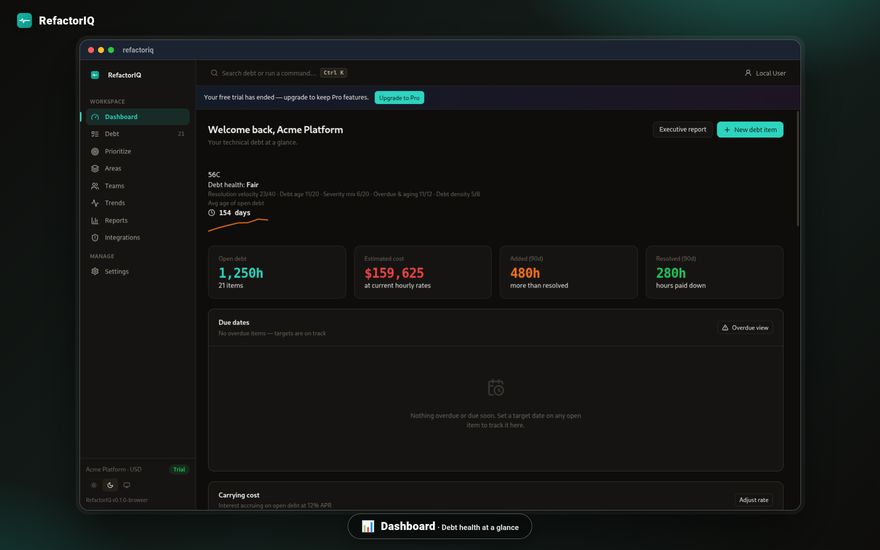
Rituals that reduce load
- Rotation: no one owns legacy pain alone more than one sprint.
- WIP 1: finish draining work before starting new to expose the bottleneck. Pair this with psychological safety to raise tech in the same monthly review; teams that track both catch burnout before it becomes attrition.
Protect flow — track friction offline.
Download RefactorIQWhat DX work does not do
DX improves flow and retention; it does not set financial hurdle rates, derive estimate distributions, or migrate architectures. Fix the human cost here — hand budgets and code patterns to their own tracks.
Worked example: pricing this in dollars per day
Here is the arithmetic behind the argument. Take a single item from this guide and price it the way the calculator on the product page does it:
principal = hours × blended rate
daily carrying cost = principal × APR ÷ 365
| Input | Value | What it tells you |
|---|---|---|
| Effort to fix | 14 h | Your estimate of the work, not the wish |
| Blended rate | $75/h | Loaded cost, not salary |
| Principal | $1,050 | The value sitting in the code |
| APR | 12% | Drag: slower changes, bugs, onboarding tax |
| Daily carry | ~$0.35/day | What waiting costs today |
| Yearly carry | ~$126/yr | What waiting costs for twelve months |
Run the same row twice before you believe it. Halve the hours and the carry still lands near $63 a year; double them and it is ~$252. At portfolio scale those per-item ranges are the difference between a defensible investment and a number nobody in the room trusts.
One quarter of drift on this item costs about $32. That figure is the whole argument — it is small enough to be ignored in a roadmap review and large enough to matter once it compounds across a backlog.
What this guide does not cover
This post stays narrow on purpose. It does not go into CFO NPV/IRR, PERT beta math, or architecture migration code steps, because those are separate decisions with their own inputs and their own audience. If you are weighing mentorship Load Senior Devs Stuck Maintaining Legacy Code specifically, read this alongside Track Rework Rate As Tech Debt Burnout Signal Dashboard rather than trying to stretch either one to cover the other.
Key takeaways
- Price it before you argue about it. 14 hours at $75/h is $1,050 of principal; the debate about whether it matters stops being subjective once the number exists.
- Carry compounds quietly. ~$0.35 a day and ~$126 a year for this item, and it costs nothing to keep paying it.
- Name an owner and a date. Debt without a trigger is a wish; debt with a trigger becomes a line item.
- Show the range. Halve the estimate and the number still holds. If it does not, the estimate needs work, not the argument.
- Next step. Roll these up; a portfolio number outlives a single sprint.
FAQ
How to measure mentorship load senior devs stuck maintaining on my team?
Start with mentorship Load Senior Devs Stuck Maintaining Legacy Code: about 14 hours of work at a blended $75/h, or $1,050 of principal carrying roughly $0.35 a day. State that number, then the single business outcome it protects, then ask for dated capacity. If the ask is declined, log it with a revisit trigger so the decision stays visible to the vp of engineering.
What benchmark proves mentorship load senior devs stuck maintaining hurts retention?
Anchor on the item you can defend: about 14 hours at a blended $75/h is $1,050 of principal, which carries roughly $0.35 per day or $126 per year at 12%. Treat that as an estimate, not a promise — the point is that the order of magnitude survives every reasonable assumption.
How to reduce mentorship load senior devs stuck maintaining without extra headcount?
Start with mentorship Load Senior Devs Stuck Maintaining Legacy Code: about 14 hours of work at a blended $75/h, or $1,050 of principal carrying roughly $0.35 a day. State that number, then the single business outcome it protects, then ask for dated capacity. If the ask is declined, log it with a revisit trigger so the decision stays visible to the vp of engineering.