Incremental Refactoring User Story Splitting Techniques
Incremental Refactoring User Story Splitting Techniques — a focused guide for tech leads: what to do, what to measure, and what to avoid so this work stays separate from adjacent efforts.
The sprint system for this work
Incremental Refactoring User Story Splitting Techniques works when debt lives in the same backlog with the same fields: owner, size, cost-of-delay, and age. Create a dedicated label, require those four fields, and review the top 10 by cost-of-delay every refinement. Context: tracking beyond tickets and debt basics.
Capacity math the team can keep
Protect 15–20% of velocity for this category, fixed for the quarter. Example: 40-point velocity → 6–8 points reserved. Track drag as planned versus delivered when debt-heavy modules are touched; if predictability drops two sprints in a row, hold the buffer — do not borrow it for scope. Size with the same unit as features so trade-offs are visible.
| Field | Required | Example |
|---|---|---|
| Owner | Yes | Team + name |
| Size | Yes | 8 pts/h |
| Cost of delay | Yes | High/Med/Low |
| Friction hits | Yes | Count/sprint |
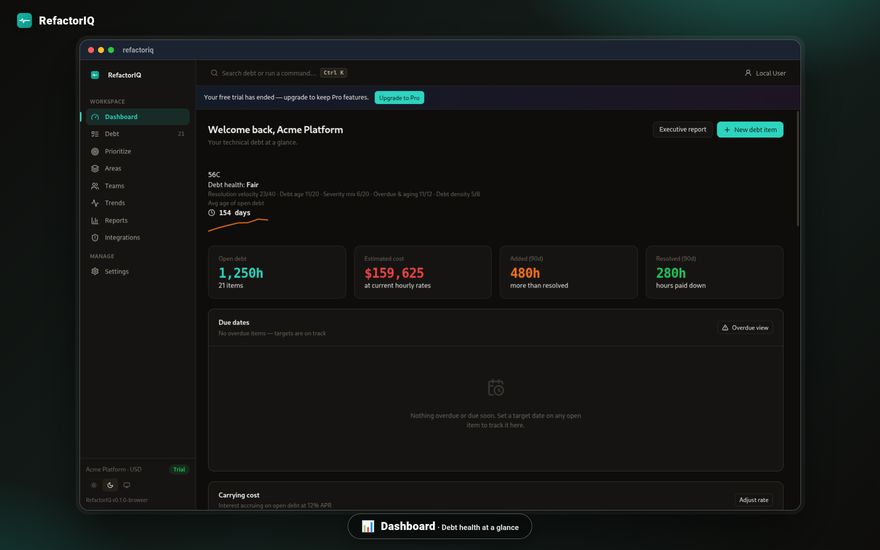
See capacity math in the product tour.
See payoff planningCeremony: 30-minute weekly flow
Groom: add missing fields. Score: cost-of-delay × age ÷ size. Commit: pull top scorers into the protected buffer. Retro: log friction incidents (blocked deploys, flaky suites, slow reviews) with counts. Automate stale-ticket flags after 60 days without owner or re-score. The goal is predictability — fewer surprises from incremental refactoring user story splitting techniques — not process theater.
Two traps to avoid
- Buffer theft: borrowing the 20% for features every sprint — protect it like on-call time.
- Label graveyard: tickets with no owner or score — auto-close or re-score monthly.
Plan payoff against real capacity — offline, no migration.
Download RefactorIQWhat sprint process does not do
Sprint process sequences work; it does not price dollars, model statistical uncertainty, or fix architecture. Use scores and buffers here to order the work — hand valuation and code design to their own reviews.
Worked example: pricing this in dollars per day
Before this goes near a planning meeting, make it concrete. Take a single item from this guide and price it the way the calculator on the product page does it:
principal = hours × blended rate
daily carrying cost = principal × APR ÷ 365
| Input | Value | What it tells you |
|---|---|---|
| Effort to fix | 8 h | Your estimate of the work, not the wish |
| Blended rate | $75/h | Loaded cost, not salary |
| Principal | $600 | The value sitting in the code |
| APR | 12% | Drag: slower changes, bugs, onboarding tax |
| Daily carry | ~$0.20/day | What waiting costs today |
| Yearly carry | ~$72/yr | What waiting costs for twelve months |
Run the same row twice before you believe it. Halve the hours and the carry still lands near $36 a year; double them and it is ~$144. Knowing which end of that range you are on is what lets you promise a date instead of a hope.
One quarter of drift on this item costs about $18. That figure is the whole argument — it is small enough to be ignored in a roadmap review and large enough to matter once it compounds across a backlog.
What this guide does not cover
This post stays narrow on purpose. It does not go into dollar ROI/CFO models, PERT SD derivations, or monolith code patterns, because those are separate decisions with their own inputs and their own audience. If you are weighing incremental Refactoring User Story Splitting Techniques specifically, read this alongside API Versioning Debt Cleanup Strategy SaaS rather than trying to stretch either one to cover the other.
Key takeaways
- Price it before you argue about it. 8 hours at $75/h is $600 of principal; the debate about whether it matters stops being subjective once the number exists.
- Carry compounds quietly. ~$0.20 a day and ~$72 a year for this item, and it costs nothing to keep paying it.
- Name an owner and a date. Debt without a trigger is a wish; debt with a trigger becomes a line item.
- Show the range. Halve the estimate and the number still holds. If it does not, the estimate needs work, not the argument.
- Next step. Bring the range to planning so the estimate is argued, not assumed.
FAQ
How to prioritize incremental refactoring user story splitting techniques without blocking features?
Start with incremental Refactoring User Story Splitting Techniques: about 8 hours of work at a blended $75/h, or $600 of principal carrying roughly $0.20 a day. State that number, then the single business outcome it protects, then ask for dated capacity. If the ask is declined, log it with a revisit trigger so the decision stays visible to the tech lead.
What template works best for incremental refactoring user story splitting techniques?
One page, four rows: the item, the effort (8 h), the principal ($600), and the payoff. A $75/h blended rates reading one is your opening line; the rest is the ask. Keep the $0.20/day carry on the page so nobody has to recompute it in the meeting.
How much capacity for incremental refactoring user story splitting techniques per sprint?
Anchor on the item you can defend: about 8 hours at a blended $75/h is $600 of principal, which carries roughly $0.20 per day or $72 per year at 12%. Treat that as an estimate, not a promise — the point is that the order of magnitude survives every reasonable assumption.